The packet

Twelve pages, built for one block.

A captain does not get a login, a dashboard, or a training. She gets an envelope. Inside it is her own street, sized as a job she can finish, and the four or five things she needs to walk it. Here is every page of it.

PDF · 12 pages · no email required
Page by page

What's in the envelope.

The welcome letter

Why this person and not somebody else -- she votes in every general election, and the doors are already hers to walk. It ends with the one thing to do first, so the packet does not become a thing to read later.

The block sheet

Her precinct sized as a job, then her ten nearest doors. Behind each door: every registered neighbor, their November record, how each ballot was actually cast -- early, by mail, or on the day -- and one line on what to say to them.

The street map

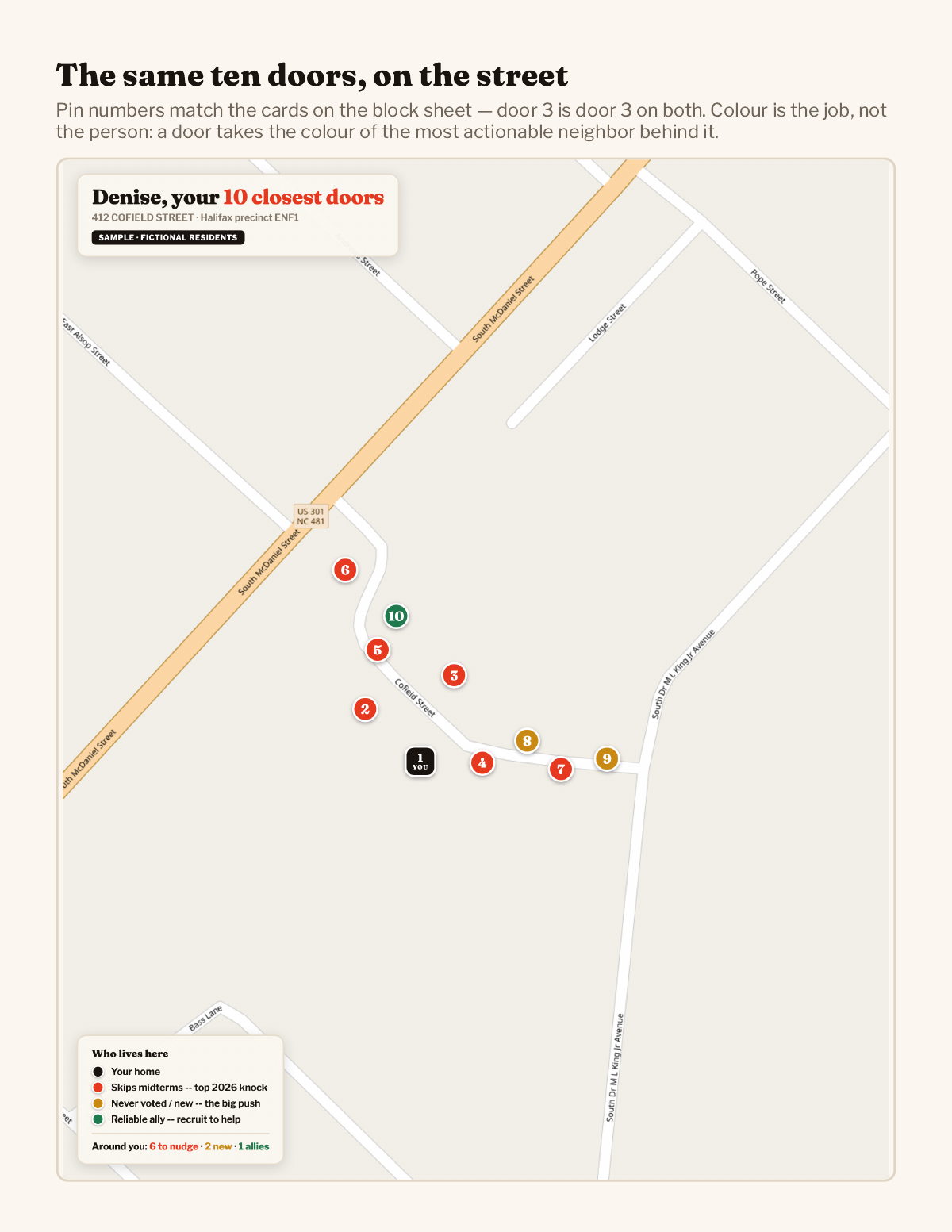
The same ten doors, the same numbering, on her own streets. Colour is the job: red skips midterms, gold has never voted, green already votes and can help knock. She can hold the map and the sheet side by side and they agree.

The Play

One page on how to talk to a neighbor about voting -- what to open with, what to do when someone is busy, and when to leave. It is short on purpose.

The voting-plan card

The four questions that turn a yes into a ballot actually cast: when, where, how you're getting there, and what you need to bring. A yes without a plan does not show up in the count.

The key dates

North Carolina's 2026 calendar, verified against the State Board of Elections. The single most useful fact a captain carries is that same-day registration is available throughout early voting.

Why this one is public

A real packet can never be shown to you.

Every genuine packet carries neighbors' names, home addresses and voting histories. It belongs to the captain and goes nowhere else -- not to a funder, not on this website.

So the sample solves it by inventing the precinct. Every resident, age, address and ballot in it is made up, and so are the precinct counts and the polling place.

What is real is the software. Every page after the cover was produced by the same builders that make a live packet, run against the fictional county with nothing changed but the database they read. The streets on the map are real centerlines in Enfield, Halifax County, and the mix of how ballots get cast is Halifax's own measured 2022 split. You are holding the product, not a picture of it.

Download the sample packet

A page from the sample packet: ten numbered doors on a captain's own streets, coloured by who behind each one skips midterms, has never voted, or already votes and can help knock.
How the data is handled

Local files, and nothing leaves them.

  • Packets are built from the public statewide voter file, voter history, official polling-place files, AddressNC, and NC OneMap precinct boundaries. No paid APIs.
  • The build reads and writes local files only. No voter data is sent to any third-party map or AI service. Geocoding runs against local address-point files, with cached public Census geocoder responses as fallback.
  • Generated packets carry names and addresses and are excluded from version control. Nothing household-level is ever published.
  • Some addresses will not geocode and stay blank rather than being guessed at.
  • The voter file is current registration only. Full historical address moves are not reconstructable.
  • Birth month and day are not in the public voter file, so any date-based output uses registration date as a public-data proxy and says so on the page.

You'd walk your own ten doors.

If you're in North Carolina and you vote in every general election, tell us where you live and we'll build your packet. Free, and not a party job.

Get the ten houses closest to yours →

You want to run this somewhere.

The build is county-configurable and the pilot design is already written. Tell us the county you care about.

Fund or run a pilot →